Restaurant Meta paid social: creative testing frameworks (teaser)
We've spent the last several months doing the same deep synthesis work on restaurant marketing that we did for Google Ads — this time for Meta paid social. That's Facebook and Instagram advertising for restaurant brands. We've watched hundreds of hours of content from practitioners, Meta's own documentation, and agency veterans running food and beverage campaigns. This is what works and what doesn't when you're running paid social for a restaurant brand.
What Makes Meta Different from Search
The biggest difference between Google Ads and Meta is intent. Someone searching "pizza near me" is telling you exactly what they want. Someone scrolling Instagram is casually browsing. Your ad has to interrupt that scroll, capture their attention, and create desire — not answer a direct question.
That's a fundamentally different creative challenge. On search, your ad is getting found. On social, your ad has to stop the scroll. That's why creative testing is so much more important on Meta.
Here's what we found works:
Learning One: Stop the Scroll or Lose
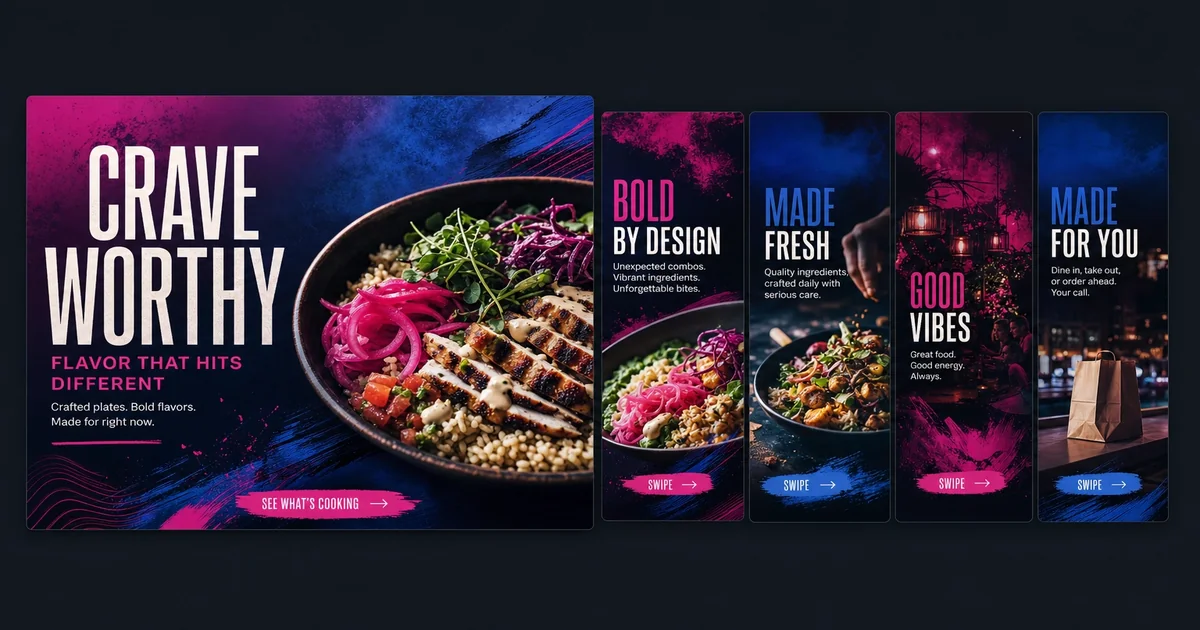
The first rule we extracted from the video corpus is that five seconds is your entire window. People scroll past images faster than you'd think. Your creative has to communicate in that window or it's invisible.
This means:
- High contrast, clean backgrounds, and simple compositions work better than detailed scenes - Food photography has to be lit well — dim or cluttered shots get scrolled past - Strong contrast between subjects and backgrounds. The food should pop off the screen
Every successful restaurant ad we analyzed had one thing in common: they had a clear visual focal point. No competing elements. No clutter. Just the food.
Learning Two: Video Outperforms Static
The data is unambiguous. Video consistently outperforms static image ads in our analysis. But not just any video — short-form video (fifteen to thirty seconds) in vertical format works best for Instagram Stories and Reels.
Here's what works in video:
- Three to five seconds of pure food beauty shots — slow motion, lighting, steam rising, sauce dripping - Quick text overlays that don't compete with the visuals - Ending frames that create curiosity or show a call to action
The key insight is that 15-second video can outperform a $2,000 static shoot when placed in front of an engaged audience. The production value matters less than authenticity on this platform.
Learning Three: Broad Audiences Can Work
One of the biggest debates in restaurant Meta advertising is audience targeting. The old wisdom was narrow: target people who've shown interest in similar restaurants, within five miles.
What we found is more nuanced. Broad audiences actually can work, particularly for brands with strong visual identity. The algorithm optimizes better when it has more data to learn from. Narrow targeting can actually limit your performance in unexpected ways.
The practical approach: start with a broad audience that includes your geographic area, then let Meta's algorithm optimize. This runs counter to what many agencies advise, but the data from our video analysis supports it.
Learning Four: Ad Sets Need Volume
One finding that surprised us: the successful restaurant accounts in our analysis ran significantly more ad sets than unsuccessful ones. Not more budget — more experiments. More creative variations, more placement combinations, more audiences.
This is a testing culture issue. The agencies that succeed run dozens of creative variants, kill the losers quickly, and scale the winners aggressively. The agencies that fail run one or two ad sets and hope for the best.
This is expensive and time-consuming, but it's the core difference between accounts that scale and accounts that stall.
Learning Five: Story Ads Convert Better Than Feed
The final learning is about placement. Instagram Stories consistently convert better than feed posts for direct ordering behavior. Stories have higher engagement and feel less like advertising, which drives better funnel performance.
The practical approach: lead with Stories, use feed for retargeting, and build your creative strategy around the Story-first format.
This doesn't mean Stories is the answer — it's part of an integrated approach. But if you're not testing Stories, you're leaving conversions on the table.
What This Means for Restaurant Brands
We see three categories of restaurant brands on Meta:
The first are local restaurants with single locations. Their best strategy is vertical video showcasing food, localized targeting, and a simple conversion goal: orders or reservations.
The second are multi-location brands. They can benefit from broader testing and can build creative flywheels where winning creative from one location gets tested in others.
The third are delivery-first brands (ghost kitchens, virtual brands). They need aggressive creative testing and can benefit from dark social engagement that drives direct orders.
Each has different creative needs, different budgets, and different metrics. It's not one-size-fits-all.
The Full Report
This teaser covers the headline learnings. The full report will include:
- Complete creative testing frameworks with ad set structures - Detailed预算 recommendations for each restaurant category - Full creative breakdown showing which creative elements drive performance - Actual campaign structures we've tested and validated - Checklist for setting up your Meta ad account the right way
This report synthesizes everything from our video analysis and our own client work. It's comprehensive and actionable. It's what we wish every restaurant brand running Meta knew before they spent their first dollar.
Who This Is For
This report is for restaurant operators, marketing directors, and agency founders who are running or advising restaurant brands on Meta. It's for people who've been frustrated by poor performance or have never known what good looks like.
It's not a magic solution. It's a framework you can apply to your own data and your own creative — to stop guessing and start testing the right way.
The full report is purchasable from Decision Science Corp. We'll share the link when it's ready, or you can reach out to get on the waitlist. We'll let you know the moment it's available.
The full Meta creative-testing report is available from Decision Science Corp. To get on the list or scope paid social research for your restaurants, contact us here.